Flat Pack Containers: Flexible Storage for Restricted-Access Sites
Discover how flat pack containers provide portable, expandable storage for gardens, schools, construction sites and restricted-access locations.
Flat Pack Containers: Flexible Storage for Restricted-Access Sites
Delivering a traditional shipping container is not always possible. Narrow gates, enclosed gardens, low entrances and restricted construction sites may prevent a delivery truck or crane from reaching the final placement area.
Flat pack containers solve this problem by arriving in separate sections that can be moved into position and assembled on-site. They can provide flexible storage for properties where a fully assembled container cannot be delivered.
Browse CargoVault’s flat pack container category to compare available configurations.
What Is a Flat Pack Container?
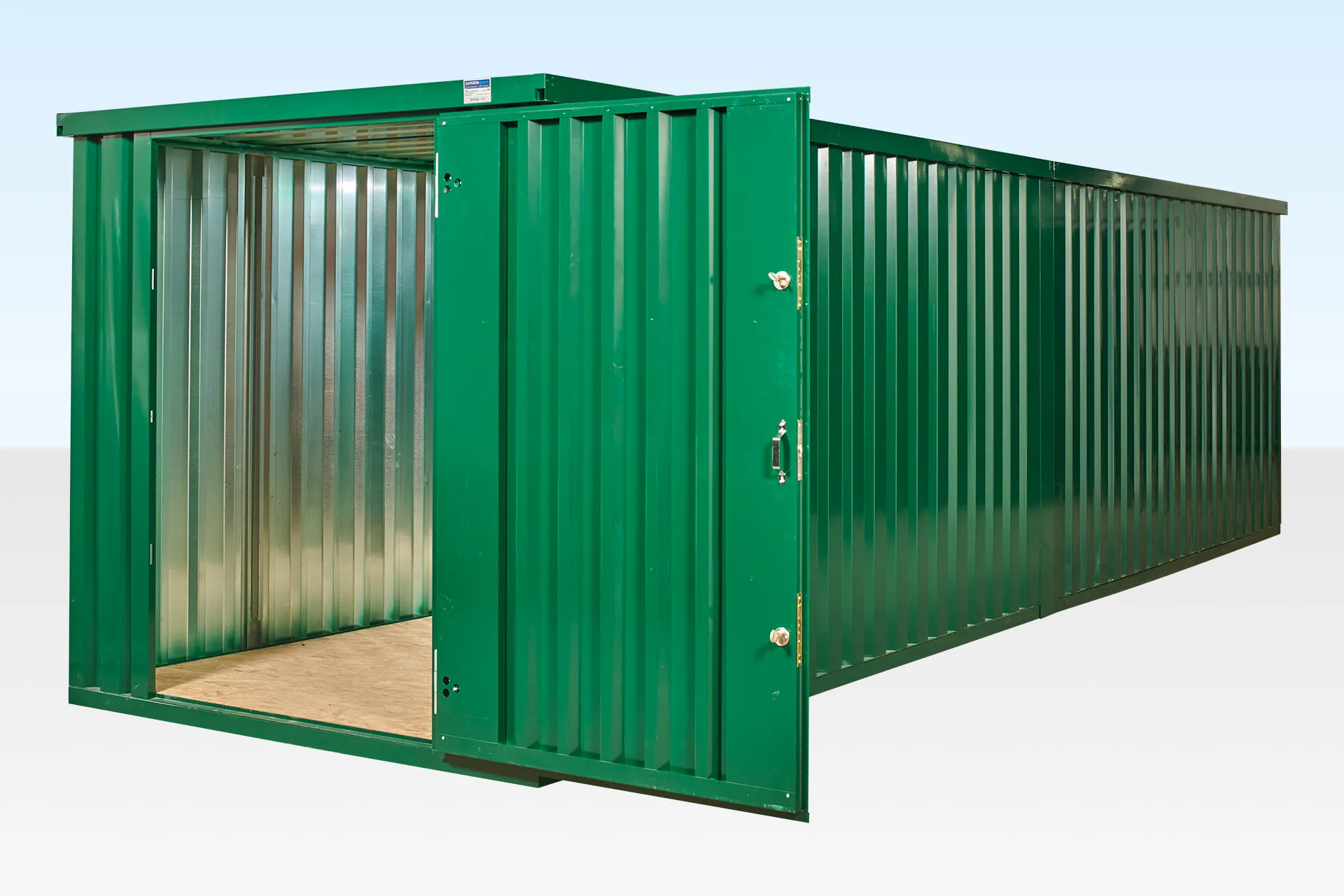
A flat pack container is a modular steel unit supplied in panels or sections instead of as one fully assembled structure.
Depending on the model, the separate components can be transported through restricted access points and assembled at the final location.
A typical flat pack unit may include:
- Steel wall panels
- Floor and roof sections
- Corner posts
- Personnel or double doors
- Locking systems
- Bolted connections
- Optional windows
- Ventilation
- Interior flooring
Always follow the manufacturer’s assembly instructions, lifting guidance and handling requirements.
Is a Flat Pack Unit a Shipping Container?
A flat pack container can provide secure portable storage, but it should not automatically be treated as an ISO freight container.
Many flat pack units are designed for stationary storage rather than:
- International cargo transportation
- Loaded lifting
- Freight-terminal handling
- Conventional container stacking
- Repeated crane movement
- Heavy cargo loads
If transportation, stacking or lifting while loaded is required, request written confirmation that the selected unit is designed for that purpose.
Where Are Flat Pack Containers Useful?
Flat pack storage units can be suitable for:
- Residential gardens
- Construction sites
- Schools and sports clubs
- Community facilities
- Temporary businesses
- Remote work areas
- Properties with narrow entrances
- Enclosed courtyards
- Locations where crane access is unavailable
- Sites requiring temporary equipment storage
They are particularly useful when the final placement area is accessible to people but not to a large delivery vehicle.
Advantages of Flat Pack Storage
Easier Access
The separate components can reach areas that may be inaccessible to a fully assembled shipping container.
Before ordering, measure the narrowest:
- Gate
- Doorway
- Passage
- Corridor
- Stairway
- Turning point
Compare these measurements with the dimensions and weight of the largest flat pack component.
Modular Expansion
Compatible units can sometimes be connected side by side or end to end. This allows the storage area to expand as requirements grow.
Only connect units that are designed to work together. Roof drainage, structural connections, weather sealing and foundations should be planned before expansion.
Simple Relocation
Some flat pack units can be disassembled and moved when a project ends or the site layout changes.
Repeated relocation should follow the manufacturer’s instructions to avoid damaging panels, seals and connection points.
Compact Transportation
When disassembled, flat pack units require less transportation and storage space than fully assembled containers. Multiple units may be transported efficiently, depending on their design.
Multiple Applications
Flat pack units can become:
- Tool stores
- Equipment stores
- Garden storage
- Construction-site stores
- Kiosks
- Temporary offices
- Sports-equipment rooms
- Maintenance stores
- Secure inventory areas
Occupied applications may require insulation, ventilation, electricity, heating, emergency exits and local approval.
Flat Pack vs Standard Shipping Containers
| Requirement | Flat pack container | Standard shipping container |
| Delivery format | Supplied in sections | Delivered fully assembled |
| Restricted access | Excellent | Requires vehicle or crane access |
| On-site assembly | Required | Not normally required |
| Heavy-duty storage | Depends on model | Generally more suitable |
| Cargo transportation | Usually not intended for freight | Designed for cargo use when appropriately certified |
| Relocation | Can potentially be disassembled | Moved as a complete unit |
| Modular expansion | Possible with compatible models | Requires professional modification |
| Cargo-door access | Depends on configuration | Large end doors are standard |
| Stacking | Only when specifically approved | Possible for suitable units under professional planning |
| Best application | Restricted-access and flexible storage | Heavy-duty storage and cargo handling |
Browse CargoVault’s 20ft shipping containers and 40ft shipping containers when a traditional unit is more appropriate.
Flat Pack Container or Modular Building?
A flat pack container may suit simple storage or a compact temporary workspace.
For larger prefabricated spaces containing several rooms, corridors, offices or welfare facilities, a modular building may be more appropriate.
Read CargoVault’s modular container building guide for additional planning information.
Prepare the Installation Area
Flat pack containers need a firm, level and properly drained base. An uneven surface can affect assembly, door alignment and long-term stability.
Before installation:
- Clear vegetation and debris.
- Check the ground condition.
- Confirm that water drains away from the unit.
- Measure the available area.
- Leave sufficient room around the doors.
- Identify underground services.
- Check local planning requirements.
- Confirm that every component can reach the site.
- Arrange qualified assembly assistance where necessary.
- Follow the manufacturer’s foundation guidance.
CargoVault’s site-preparation checklist can help you evaluate the location.
Assembly Considerations
Before assembly, confirm:
- The number and weight of components
- Tools and equipment required
- Number of installers needed
- Safe lifting methods
- Assembly sequence
- Foundation dimensions
- Door orientation
- Roof-drainage direction
- Required working space
- Weather conditions
- Manufacturer’s warranty requirements
Do not attempt to lift heavy panels without suitable equipment and enough experienced people.
After installation, check that:
- The unit is square and level
- Doors open and close correctly
- Roof and wall connections are secure
- Seals are properly positioned
- Water drains away from the structure
- Locks operate correctly
Security and Weather Protection
Check the locking system, panel connections, roof drainage and door seals before placing valuable equipment inside.
Security measures may include:
- Suitable padlocks
- Protected locking points
- Exterior lighting
- Security cameras
- Controlled site access
- Alarm systems
- Internal lockable cabinets
CargoVault’s site security and safety products can support remote or exposed locations.
Weather resistance depends on correct assembly, stable foundations and properly installed seals. Inspect the unit after severe weather and periodically check for loose connections, corrosion or signs of leakage.
Flat Pack Container Buying Checklist
Before ordering, confirm:
- Assembled exterior dimensions
- Largest component dimensions
- Component weights
- Narrowest access measurement
- Door type and opening size
- Floor capacity
- Locking system
- Weather-resistance specification
- Foundation requirements
- Assembly instructions
- Required tools and personnel
- Expansion compatibility
- Disassembly and relocation process
- Delivery arrangements
- Intended storage contents
- Local planning requirements
- Written warranty
Frequently Asked Questions
Can flat pack containers pass through narrow gates?
Often, yes. However, you must compare the narrowest access point with the dimensions of the largest individual component.
Are flat pack containers waterproof?
Weather resistance depends on the model, assembly quality, seals, roof connections and foundation. Confirm the manufacturer’s specification before storing moisture-sensitive goods.
Can flat pack containers be connected?
Compatible models may be connected side by side or end to end. Use only approved connection methods and plan foundations and drainage carefully.
Can a flat pack container be moved after assembly?
Some units can be disassembled and relocated. Follow the manufacturer’s instructions to prevent damage to panels and seals.
Can flat pack containers be used as offices?
Yes, when the unit is properly configured for occupancy. Insulation, ventilation, electricity, emergency access and local building requirements must be considered.
Can flat pack containers be stacked?
Only when the manufacturer specifically approves stacking for that model and configuration. Never assume a storage unit can be stacked like an ISO freight container.
A Practical Alternative for Difficult Locations
Flat pack containers provide flexible storage where traditional container delivery may be difficult. Their modular design makes them useful for temporary projects, growing organizations and properties with restricted access.
The correct unit should be selected according to access measurements, intended contents, assembly requirements, security and future expansion plans.
Browse CargoVault’s flat pack containers, then request a custom quote to discuss sizes, finishes, connected configurations and delivery.