
How to Prepare Your Site for Shipping Container Delivery
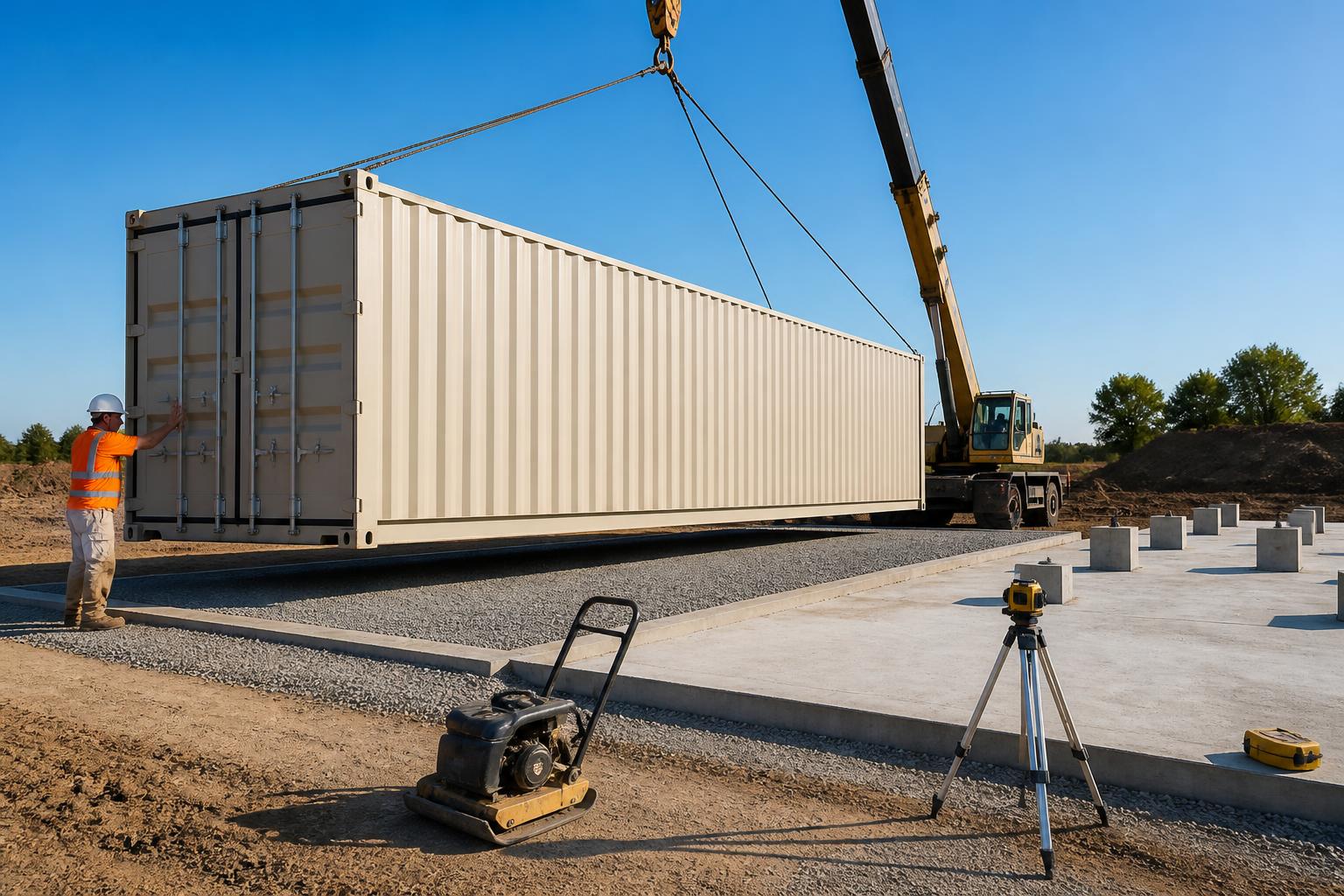
Follow this shipping container site preparation checklist to plan delivery access, foundations, drainage, utilities, and final placement.
Preparing your property correctly can make the difference between a smooth shipping container delivery and an expensive delay. The delivery truck needs a safe route to the site, enough room to unload, firm ground to operate on, and a properly prepared place to set the container.
Use this shipping container site preparation checklist before scheduling delivery. Because properties and delivery equipment differ, always send your supplier current photographs and measurements and obtain confirmation that the proposed delivery plan is workable.
Shipping Container Site Preparation Checklist
Before delivery day:
- Confirm the container’s dimensions and empty weight.
- Choose the exact placement location.
- Decide which direction the cargo doors should face.
- Check zoning, permit, setback, and association requirements.
- Confirm whether delivery will use a tilt-bed truck, side loader, or crane.
- Measure gates, roads, turns, and the unloading area.
- Check for overhead wires, branches, roofs, and other obstructions.
- Prepare a firm, level foundation with adequate drainage.
- Identify underground utilities before excavating.
- Keep septic systems, wells, irrigation, and private utility lines protected.
- Remove vehicles, equipment, waste, and other obstacles.
- Send site photographs and measurements to the delivery company.
- Arrange for an authorized adult to be present during delivery.
1. Confirm the Container Size and Delivery Method
Begin by confirming exactly which container you are purchasing. A 20-foot container and a 40-foot container have different access, turning, and unloading requirements. High-cube containers also require additional vertical clearance.
Review our shipping container dimensions, weight and capacity guide before preparing the site.
You should also ask which delivery method will be used.
Tilt-Bed Delivery
A tilt-bed truck raises one end of its trailer and allows the container to slide gradually into position as the truck moves forward. This method generally requires a reasonably straight unloading path and enough room for the truck and trailer to exit after the container touches the ground.
Tell the supplier which direction you want the cargo doors to face. The container may need to be loaded onto the trailer in a particular direction to achieve the requested orientation.
Side-Loader Delivery
A side loader places the container beside the truck using hydraulic lifting equipment. It may be useful where straight-line unloading is difficult, but it requires sufficient side clearance and stable ground for the truck and its stabilizers.
Crane Delivery
A crane may be required when the container must pass over a fence, building, wall, or another obstruction. Crane deliveries require specialized planning, suitable equipment, controlled access, and careful evaluation of overhead hazards.
Never assume that one delivery method can be substituted for another at the last moment. Confirm the equipment and placement plan before preparing the foundation.
2. Select the Exact Placement Location
Choose a location that is legal, accessible, stable, and suitable for the container’s intended use.
Consider:
- Property boundaries and required setbacks
- Local zoning and building regulations
- Easements and utility corridors
- Homeowners’ or commercial association rules
- Access for future maintenance
- Distance from buildings, roads, and neighboring properties
- Drainage patterns and areas where water collects
- Emergency and fire-service access
- The direction the container doors will face
- Space needed to open the doors completely
Container rules vary between cities, counties, and property types. Contact the appropriate local authority before making permanent site improvements.
If the property may be exposed to flooding, check the address through the FEMA Flood Map Service Center, which is the official public source for federal flood-hazard information. Local authorities may impose additional requirements.
3. Inspect and Measure the Entire Delivery Route
Preparing only the final placement area is not enough. The delivery truck must be able to travel from the public road to the unloading location and leave safely afterward.
Measure and inspect:
- Entrance and gate width
- Road and driveway width
- Sharp turns and restricted corners
- Steep slopes or sudden changes in grade
- Low tree branches
- Overhead electrical and communication lines
- Building eaves and covered entrances
- Fences, mailboxes, signs, and retaining walls
- Parked vehicles and stored equipment
- Bridges, culverts, drains, and pavement edges
- Soft shoulders and narrow turnaround areas
Delivery-space requirements depend on the container, truck, unloading method, site conditions, and driver’s approach. Do not rely on a universal clearance estimate. Consult our shipping container delivery space requirements guide, then ask the delivery provider to confirm the measurements for its equipment.
Photographs and a short video of the route can help identify problems, but they do not replace accurate measurements or the delivery company’s approval.
4. Evaluate the Ground Conditions
The delivery route and unloading area must support the truck, trailer, container, and lifting equipment. Ground that appears firm while dry may become unstable after heavy rain.
Look for:
- Soft or recently filled soil
- Mud and standing water
- Loose sand
- Deep gravel
- Uncompacted ground
- Steep or uneven slopes
- Hidden drainage channels
- Septic tanks and drain fields
- Underground vaults or utility structures
- Weak pavement edges
Do not direct a heavy delivery vehicle over a septic system, unidentified underground structure, or surface that has not been confirmed as suitable. If the driver determines that the site is unsafe, delivery may have to be postponed or the placement location changed.
Contact the supplier before delivery if rain or other weather conditions may have affected the site.
5. Prepare a Firm and Level Foundation
A shipping container should rest on a stable, level base. Uneven support can cause the container to twist, make the cargo doors difficult to operate, and create areas where water collects.
Common foundation options include:
Compacted Gravel Pad
A properly built gravel pad is a practical option for many storage-container installations. It can provide drainage and distribute the container’s weight when the soil and base are prepared correctly.
The pad should be compacted, level, and large enough for the complete container footprint. The suitability of gravel depends on the soil, drainage, climate, and intended use.
Concrete Piers or Footings
Concrete supports can elevate the container and provide defined bearing points. Their design, depth, spacing, and reinforcement should suit local soil and frost conditions.
Concrete Slab
A slab can provide a permanent, clean surface for frequently used or modified containers. However, it normally costs more and requires proper design, drainage, reinforcement, and curing before delivery.
Read our detailed guide to choosing the best foundation for a shipping container.
Avoid setting a container directly on grass, loose soil, or an improvised collection of unsupported blocks. For permanent installations, stacked containers, or containers that will be structurally modified, obtain advice from a qualified local engineer or contractor.
6. Plan for Drainage
Water should move away from the container instead of collecting beneath or around it.
Good drainage preparation may include:
- Grading the surrounding ground away from the container
- Using a compacted, free-draining base
- Extending the prepared area slightly beyond the footprint
- Keeping nearby drains and swales unobstructed
- Preventing roof runoff from flowing toward doors or foundations
- Maintaining access beneath the container where appropriate
Poor drainage can soften the supporting soil, contribute to settlement, and keep the underside of the container damp. Inspect the area after heavy rain before confirming that it is ready.
7. Identify Underground Utilities Before Digging
If site preparation involves excavation, pier installation, anchoring, trenching, grading, or driving stakes into the ground, buried utilities must be addressed first.
In the United States, contact 811 Before You Dig a few business days before excavation. Wait for utility operators to respond and follow the instructions associated with your locate request before disturbing the ground.
Remember that privately installed lines may not be included in the public utility-marking process. Examples can include:
- Septic and sewer lines
- Irrigation pipes
- Well lines
- Propane lines
- Private electrical cables
- Outdoor lighting circuits
- Lines serving detached buildings
If private utilities may be present, arrange for an appropriate private locating service or qualified contractor.
8. Clear the Unloading Area
Before the delivery vehicle arrives, remove anything that could obstruct the truck or create a safety risk.
Clear away:
- Cars and trailers
- Construction equipment
- Waste containers
- Building materials
- Low branches
- Temporary fencing
- Outdoor furniture
- Children’s equipment
- Pets and livestock
Keep customers, workers, family members, and bystanders outside the delivery area. Only essential personnel should remain nearby, and everyone must follow the driver’s instructions.
If a crane is being used, no one should stand beneath or close to the suspended container.
9. Confirm the Door Direction and Final Position
Mark the intended container footprint and clearly identify which direction the cargo doors should face.
Consider how the doors will be used after delivery. They need enough room to open completely without striking a wall, fence, parked vehicle, or steep embankment. The approach should also remain accessible for moving goods in and out.
Before unloading begins, walk the placement area with the driver and confirm:
- The exact container position
- Door orientation
- Required distance from nearby structures
- Foundation alignment
- The truck’s exit direction
The driver must retain final authority over whether the unloading operation can be completed safely.
10. Complete a Delivery-Day Inspection
Once the container has been placed, inspect it before the delivery vehicle leaves when practical.
Check that:
- The container is in the agreed location.
- The doors face the correct direction.
- All supporting points are stable.
- The container appears level.
- Both doors open and close correctly.
- The locking bars operate normally.
- The roof and walls have no new delivery damage.
- Water can drain away from the base.
- The container does not rock or shift.
If the doors are difficult to operate, do not immediately force or modify them. First check whether the container is level and properly supported.
Special Site Situations
Sloped Properties
Placing a container on a slope may require grading, retaining work, engineered footings, or a different delivery method. Do not try to compensate for a significant slope with loose blocks or unstable packing materials.
Soft or Wet Ground
Delivery may need to be rescheduled until the ground becomes firm. Road mats or other access measures may help in some situations, but they must be discussed with the delivery company in advance.
Residential Properties
Residential deliveries often involve narrow driveways, landscaping, neighboring vehicles, overhead service lines, and local placement rules. Measure the complete route instead of judging access visually.
Modified or Occupied Containers
Containers intended for offices, workshops, homes, or other occupied uses may need engineered foundations, utility planning, permits, insulation, ventilation, and code-compliant modifications. These requirements should be established before delivery.
High-Wind or Severe-Weather Areas
Anchoring requirements depend on the location, soil, container configuration, exposure, and applicable codes. Ask the local authority or a qualified engineer whether the container requires a designed anchoring system.
Common Site-Preparation Mistakes
Avoid these frequent problems:
- Preparing the pad without measuring the delivery route
- Assuming the truck can make a sharp turn
- Forgetting to specify the cargo-door direction
- Ignoring overhead wires or branches
- Scheduling delivery immediately after heavy rain
- Placing the container where water naturally collects
- Building a foundation before confirming the container dimensions
- Driving over septic systems or unidentified underground structures
- Excavating without locating utilities
- Leaving vehicles or materials in the unloading zone
- Assuming photographs alone prove that the site is accessible
Frequently Asked Questions
Does a shipping container always need a concrete foundation?
No. A concrete foundation is not necessary for every installation. Depending on the soil, drainage, container use, and local requirements, a compacted gravel pad or properly designed piers may be suitable. Permanent and modified installations may require engineered foundations.
Can a shipping container be delivered over grass?
Possibly, but only when the ground is firm enough for the delivery vehicle and conditions are acceptable to the driver. Wet or soft grass can hide unstable soil and may cause a heavy truck to become stuck or damage the property.
How level must the container site be?
The base should provide stable and even support so the container does not twist or rock and its doors operate correctly. Significant slopes or uneven foundations should be corrected before delivery.
Should I be present during delivery?
Yes. An authorized adult who understands the placement plan should be available to confirm the position and door direction and answer the driver’s questions.
What happens if the site is not ready?
The driver may choose a different safe placement location or decline to unload. Redelivery or waiting charges may apply depending on the supplier’s terms, so report potential access or ground problems before the truck is dispatched.
Plan Your Container Delivery with Confidence
Good shipping container site preparation protects the property, reduces delivery delays, and helps the container remain stable after placement. Confirm the size, delivery equipment, access route, foundation, drainage, and final orientation before setting the delivery date.
Review our delivery information or request a shipping container quote. Include the delivery address, preferred container size, site photographs, access measurements, surface conditions, and desired door direction so our team can evaluate your requirements.